Solar Screens vs. Window Tint in Las Vegas: Which Cuts Heat Better?
In a Las Vegas summer, the goal is the same whether you choose solar screens or window tint: keep the desert sun from cooking your rooms and your AC bill. But they attack the problem from opposite sides of the glass. Solar screens are an exterior mesh that shades the window before the sun hits it. Window tint is a film bonded to the inside of the glass that rejects heat after it's already reached the pane. That difference drives almost every tradeoff below — heat performance, warranty risk, the view, curb appeal, and cost.
Quick honesty note up front: we build and install solar screens, not window film, so we have a horse in this race. But the physics here is the physics, and we'll tell you straight where tint is genuinely the better tool for a specific window. The goal is to help you pick the right thing per window, not to pretend one option wins everywhere.
The Core Difference: Outside the Glass vs. On the Glass
This is the whole ballgame, so it's worth being precise about it.
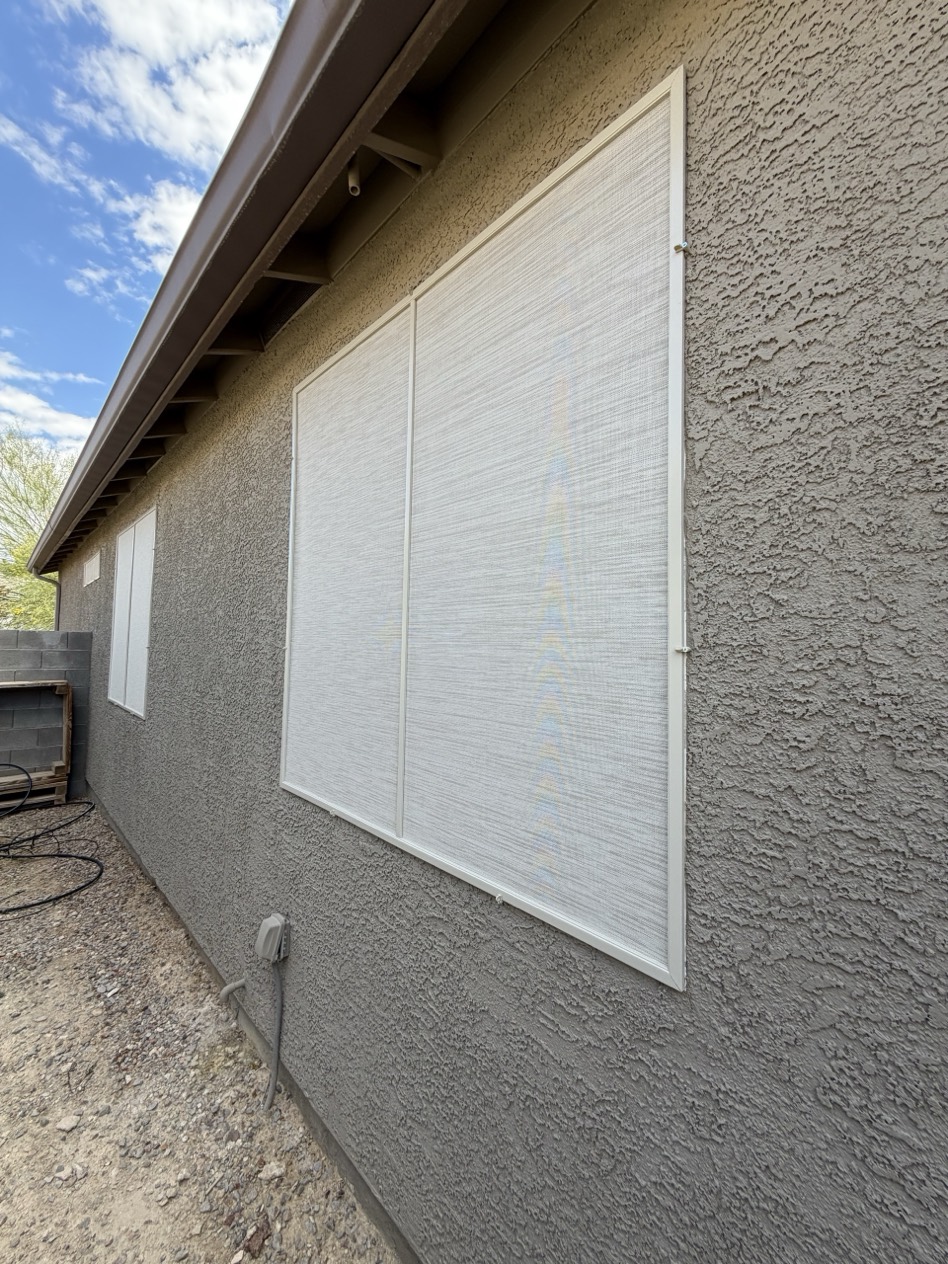
Solar screens hang in front of your window like a fine, dense insect screen woven to block sun. Sunlight hits the mesh first; most of the solar energy is absorbed or deflected outside the glass and radiated back into the open air, where it can't heat your home. Only what gets through the weave reaches the window at all.
Window tint is a thin film applied to the interior face of the glass. Sunlight passes through the outer pane, crosses the air or gas gap in a dual-pane window, and only then meets the film. Good ceramic films reject a large share of the infrared (heat) energy at that point — but by then some of that energy has already been absorbed by the glass itself, which warms up and re-radiates heat inward.
So the simplest way to think about it: shading a window from the outside is more thermodynamically effective than treating it from the inside. That's true of solar screens, exterior shades, awnings, and trees alike. It's why exterior shading is the heat tool of choice for the worst-exposed glass in a brutal climate like ours.
Which Actually Blocks More Heat?
For pure heat-gain reduction on the hot faces of a Las Vegas home, solar screens win — not because film is bad, but because stopping the sun before it reaches the glass beats rejecting it afterward. An 80–90% solar screen blocks the large majority of solar heat and UV out at the mesh, so the window behind it stays dramatically cooler to the touch on a 110°F afternoon.
That said, premium ceramic and spectrally-selective films are genuinely good at rejecting infrared heat and can make a real difference, especially on windows where an exterior screen isn't practical. Cheap dyed films, on the other hand, mostly cut visible light and glare without rejecting much actual heat — they make a room dimmer without making it much cooler. If you go the tint route, the quality of the film matters enormously.
The honest summary: on a west-facing living room that bakes from 3 PM to sunset, an exterior solar screen will out-cool a typical tint job. On a window where screens won't work, a high-end ceramic film is a strong second choice.
The Dual-Pane Warranty Catch
This is the single most overlooked issue with window film in the desert, and it's the reason a lot of Las Vegas homeowners land on screens.
Most modern Vegas homes have dual-pane, Low-E windows. Many of those windows come with a manufacturer glass warranty — and a large number of those warranties are voided if you apply aftermarket film. The reason isn't fine-print pettiness: film changes how much heat the glass absorbs and holds. That extra absorbed heat raises the risk of thermal stress cracks, particularly on large panes, panes that are partly shaded by an overhang, and during the extreme hot-to-cool swings a Vegas summer throws at glass every single day.
So before you tint any dual-pane window, you need to do two things: confirm your window manufacturer's warranty allows film (and which films), and confirm the tint installer's warranty covers seal failure or glass breakage. Reputable tint shops know this and will check it for you.
Exterior solar screens sidestep the whole issue. They sit in front of the glass and don't bond to it, change its heat absorption, or touch the manufacturer's warranty. Nothing to void, no added thermal-stress risk on the pane.
The View and Visibility
Here's where tint genuinely wins. Because film is bonded right to the glass, there's no mesh between you and the outside — a picture window framing the Strip skyline, a Red Rock ridgeline, or a Southern Highlands fairway stays crisp and sharp. A quality film can cut glare and heat while keeping the glass looking like glass.
Solar screens add a fine, dark sun-blocking mesh in front of the glass, which slightly softens the outward view. It's an easy adjustment at 80% density and more like looking through light sunglasses at 90%. For most windows that's a non-issue — you still clearly see the yard, the street, the kids on the trampoline. But on a true view window, the mesh dampens an asset you paid for. (We dig into the density tradeoff in our 80% vs 90% solar screen density guide.)
That's exactly why so many Vegas homes mix and match: screen the hot, view-poor west and south windows, and leave the prized view windows clear or filmed.
Curb Appeal and the Exterior Look
Tint is close to invisible from the street — the glass just looks like glass, maybe a touch darker or more reflective depending on the film. If keeping your home's exterior completely unchanged matters to you (or your HOA has opinions), that's a point for film.
Solar screens are visible from outside as clean, dark panels over the windows. Plenty of people like the uniform, finished look — and because our frames come in White, Black, Bronze, Tan, and Champagne, you can match them to your existing window trim so they read as intentional rather than tacked-on. But it is a change to the facade, and it's worth a quick check of your HOA's architectural guidelines before ordering, especially in master-planned communities like Summerlin and Henderson.
One underrated screen advantage: they're removable. If you ever want the totally unobstructed winter view or you're staging the home to sell, screens pop off and go back on. Film is permanent until it's scraped off.
UV Protection and Fading
Both options dramatically cut the UV that fades hardwood floors, rugs, art, and furniture — a real concern under relentless Mojave sun. Quality window film often advertises blocking up to 99% of UV, which is excellent. Solar screens block UV as a function of their density (the same 80–90% that stops the heat), which is also very effective. For practical fade protection on your interiors, either one is a big upgrade over bare glass; this isn't the category that should decide it for you.
Daytime Privacy
Solar screens add meaningful daytime privacy as a side effect of the mesh — during the day it's noticeably harder to see in from outside than to see out from inside. Reflective and darker tints also add daytime privacy, while lighter ceramic films add less. Important caveat for both: this privacy flips at night. Once your interior lights are on and it's dark outside, neither a screen nor standard film gives you nighttime privacy — you still want blinds or curtains for that.
Cost and Lifespan
Pricing varies by window count, size, and the grade of product, so treat these as how-to-think-about-it ranges rather than a quote. The bigger long-run difference is how each one ages and what happens when it wears out.
| Factor | Solar Screens | Window Tint |
|---|---|---|
| Where it works | Outside the glass — shades before heat arrives | On the glass — rejects heat after it reaches the pane |
| Heat-gain reduction | Strongest on west/south faces | Good with premium ceramic film; weak with cheap dyed film |
| View clarity | Slight mesh softening (more at 90%) | Stays crisp — no mesh in the way |
| Exterior look | Visible panels (match frame to trim) | Nearly invisible from the street |
| Window warranty | No effect — doesn't touch the glass | May void dual-pane / Low-E warranties |
| Removable? | Yes — pop off seasonally or to sell | No — permanent until scraped off |
| When it wears out | Re-mesh the frame | Scrape off and reapply |
On lifespan, both are long-lived in Las Vegas. Quality solar screen fabric typically holds up 10+ years of desert sun, the aluminum frames last far longer, and a faded screen is simply re-meshed on the same frame. Window film also lasts many years, but when UV finally makes it fade, bubble, or de-laminate, it has to be scraped off and reapplied — a messier, more involved job than swapping a screen.
So Which Should You Pick?
Match the tool to the window instead of buying one thing for the whole house:
- Brutal west and southwest windows (the ones that bake every afternoon): solar screens. Maximum heat and glare control, and the view here usually isn't precious.
- Home offices and TV rooms where afternoon glare wrecks your screens: solar screens, ideally 90% density.
- True view windows (Strip, Red Rock, fairway, Lake Las Vegas): keep them clear if you can, or use a high-quality ceramic film to preserve the crisp view.
- Windows under a manufacturer glass warranty you want to protect: solar screens, so you don't risk voiding it.
- HOA forbids exterior screens, or you want the facade untouched: tint — after confirming the window warranty allows it.
Can You Use Both?
Yes — and for a lot of Las Vegas homes that's the smartest answer. Solar screens carry the load on the hot, exposed, view-poor faces where heat is the whole problem. Window tint handles the picture windows and sliders where you want the view crisp and the exterior unchanged. They work from opposite sides of the glass, so combining them window by window is completely reasonable. The only rule: confirm your window warranty before filming any dual-pane glass.
Custom Solar Screens Built for Each Window
If the heat-blocking, no-warranty-risk, removable side of this comparison is what you're after, that's exactly what we do. We measure on-site, bring physical fabric samples in both densities and every frame color, and help you decide window by window which faces actually need screening. Every screen is custom-built to your exact opening. See our full custom solar screens service for the method, pricing breakdown, and gallery, or the dedicated pages for Summerlin, Henderson, and Southern Highlands.
Want the numbers side of the decision? See how much solar screens cost in Las Vegas, or the broader solar screens benefits and color options overview.