Solar Screen Density: 80% vs 90% — Which One for Each Window in Las Vegas?
When you order custom solar screens in Las Vegas, you pick a fabric density: 80% or 90% sun-blocking mesh. Both are made from the same Phifer and Textilene materials, both clip into the same aluminum frame, and at our shop both are priced the same — so the choice isn’t about your budget. It’s about a tradeoff between heat reduction, visibility, and how each room actually gets used.
The short version: most Vegas homes end up with both. 90% on the worst west-facing rooms where glare and heat are the enemy, 80% on the view-priority rooms where you want to see the yard or the golf course. Here’s how to think about which goes where.
What “80%” and “90%” Actually Mean
The percentage refers to how much of the sun’s energy the mesh stops before it ever reaches your glass. 80% means roughly 80 percent of solar heat and UV is absorbed or deflected on the outside of the screen; 90% means 90 percent. Both densities block the overwhelming majority of solar heat — the gap between them on a 110°F afternoon is real but modest.
The bigger user-facing difference between 80% and 90% isn’t BTU reduction. It’s how the room feels and how clearly you can see out. 90% mesh is a denser weave, which means a slightly darker view, a slightly dimmer room, and stronger privacy from the outside in. 80% mesh is a more open weave, which means brighter rooms, clearer outward visibility, and a small but real bump in heat that gets through.
Same Price Either Way
This is the part that surprises a lot of homeowners: we don’t charge more for 90% density. Some installers do — they’ll quote 90% as a “premium upgrade” with a per-screen surcharge. We don’t. The 90% mesh costs us about the same as the 80% mesh wholesale, so we pass through one price for both.
Same logic on frame finishes. All five aluminum frame colors — White, Black, Bronze, Tan, and Champagne — are priced the same. So you can mix densities and frame colors across your home with no “premium option” surcharges. Pick what works for each window, not what’s cheapest.
The Visibility Tradeoff
Here’s the practical test: stand at a window during the day with no screen. Now imagine a fine dark mesh in front of it. 80% is a noticeable but easy adjustment — you can still see leaves moving on the trees, faces of people in the yard, lane lines on the street. 90% is more like looking through dark sunglasses — you still see clearly, but it’s a moodier, more filtered view. From outside the home, both densities mostly look like clean dark mesh against the glass; the visibility difference is much bigger from inside out than outside in.
That tradeoff matters more on some windows than others. A view of the Strip from a Henderson estate, the Red Rock foothills from Summerlin, or the Southern Highlands GC fairway is a real asset — you don’t want to dampen it more than necessary. A window that just looks at the side fence or the AC compressor doesn’t care.
The Heat-Blocking Tradeoff
Both densities solve the core Las Vegas heat problem: stop solar energy before it hits the glass instead of fighting it with the AC after the fact. The difference between them on actual interior comfort is smaller than the names imply.
On a brutal west-facing room at 4 PM in July, 90% might leave the interior glass surface a few degrees cooler than 80% would. That’s a real difference, but it’s a much smaller difference than the gap between “no solar screen” and “any solar screen at all.” Both densities will dramatically cool the room compared to bare glass; 90% just gets you a little further on the worst-exposure faces.
So when do you actually need 90% specifically? Two situations:
- Worst-of-the-worst exposure: Large unshaded west or southwest windows, two-story upper-floor west-facers, picture windows where the afternoon sun has a clear path to the glass.
- Glare-sensitive rooms: Home offices behind monitors, TV rooms, and bedrooms where you want closer-to-blackout in the late afternoon. Here the visibility tradeoff is actually a feature.
Room-by-Room: Where Each Density Fits
West and Southwest Faces — 90%
Pick 90%. This is where solar screens earn their keep, and the visibility tradeoff matters less because most west-facing rooms suffer from afternoon glare anyway. Living rooms with west exposure, primary bedrooms on the southwest corner, second-story upper-floor west windows on Summerlin or Mountain’s Edge homes — all 90% candidates.
South Faces — Usually 90%, Sometimes 80%
South-facing windows take direct sun for most of the day year-round, so 90% is usually the right call. The exception is a south-facing picture window with a real view (golf course, mountain backdrop, downtown Strip skyline). For those, 80% keeps the view clear at the cost of a small amount of additional interior heat.
East Faces — 80%
East-facing windows get bright but cooler morning sun that’s less intense than the afternoon. 80% is plenty here, and the brighter room and clearer view are worth it. Kitchens facing east are particularly good 80% candidates — you want to enjoy the morning light, not block it out.
North Faces — 80% (or sometimes skip the screen)
North-facing windows get minimal direct sun, so the heat-blocking benefit of solar screens is limited. If you do install screens here (for UV protection, pollen control, or visual consistency across the home), pick 80% to avoid making the room feel closed off. Some homeowners skip screens on the north face entirely.
Bedrooms — Depends on Sleep Style
If you want closer to blackout for late-afternoon sleep or shift work, 90% is the better pick — it cuts more daylight and reduces glare on the bed. If you want a bright airy bedroom that still feels bright when you walk in during the day, 80% keeps the room feeling more open. Most Vegas bedrooms end up with 90% on the west side and 80% on the east.
Home Offices and TV Rooms — 90%
Anywhere you have a screen (computer monitor, TV, tablet) competing with sun for attention, 90% wins. The denser mesh kills glare without making the room feel dark, and you stop fighting the sun every afternoon to see your screen.
Kitchens — Usually 80%
Kitchen windows are usually the place you watch the kids in the yard, the dog at the back door, or the grill on the patio. 80% keeps that view clearly available. Heat reduction matters less here because of the existing AC airflow and the heat the kitchen itself produces.
Picture Windows With Real Views — 80%
This is the one place we consistently recommend 80% over 90% even on hot exposures. Big custom-home picture windows with downtown views, Lake Las Vegas waterfront views, MacDonald Highlands ridge views, Red Rock Canyon views — the view is the asset. Don’t mute it more than necessary.
The Mix-and-Match Approach
Most Vegas homes that order solar screens through us end up with a mix. A typical estate-home install might be:
- 90% on west-facing living-room and primary-bedroom windows
- 90% on south-facing home-office and TV-room windows
- 80% on east-facing kitchen and breakfast-nook windows
- 80% on the north-facing windows (or no screen at all)
- 80% on view-priority picture windows even if west or south facing
Same price, custom per window, one install visit. We bring physical fabric samples in both densities to the free on-site measure so you can hold each one up to the actual window before committing.
What About Frame Color?
Density and frame color are independent decisions. You can mix any density with any of the five frame finishes (White, Black, Bronze, Tan, Champagne), and we recommend matching frame color to your existing window trim rather than to the fabric density. So a 90% screen on a west-facing window with bronze trim gets a bronze frame; the 80% screen next door on the east face gets the same bronze frame. Frame consistency across the home, density picked per window.
Custom Solar Screens Built for Each Window
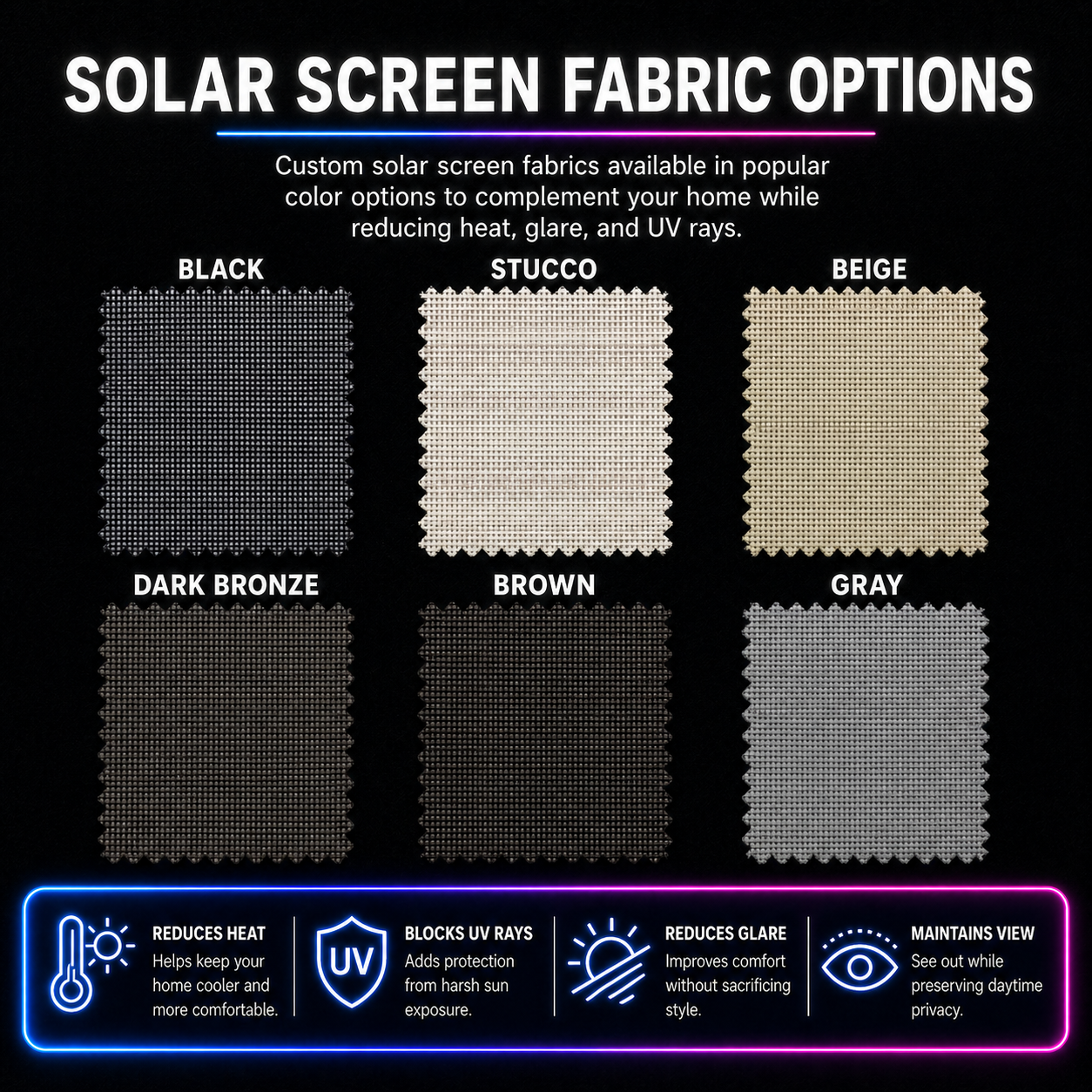
We measure on-site, walk you through fabric samples in both densities and all six fabric colors, and help you pick the right combination room by room. Every screen is custom-built to your exact opening with your selected density and frame color. Explore our full custom solar screens service for the complete method, pricing breakdown, and gallery, or check the dedicated pages for Summerlin, Henderson, Southern Highlands, and other valley areas.
Looking for the price side of the question? See our guide on how much solar screens cost in Las Vegas, or the broader solar screens benefits and color options overview.