
Pigeon Spikes vs. Mesh vs. Netting: What Actually Works on Solar Panels in Las Vegas
If pigeons are getting under your solar panels, mesh around the edge of the array is what works. Spikes and netting both have their place, just not under a home solar array. Spikes keep birds off ledges, and netting covers big open areas. Neither one closes the space under the panels where pigeons actually build their nests.
First, Know What You're Trying to Stop
When people search for pigeon control, they usually find a long list of products: spikes, nets, gels, fake owls, flashing tape, sound machines. Most of them are built to stop birds from landing or sitting somewhere.
Solar panels are a different problem. Pigeons aren't bothering you by sitting on top of the panels. They're walking under them, into the shady, sheltered gap between the panels and your roof, and building nests there. That's where the droppings, twigs, feathers, and early-morning cooing come from.
So the question to ask about any product is simple: does it close the gap? If it doesn't, the birds can keep walking right under.
Not sure if birds have already moved in? Start with our guide to the 7 signs pigeons are nesting under your solar panels.
Option 1: Bird Spikes
Bird spikes are strips of plastic or metal pins that you stick or screw onto a flat surface. They make it uncomfortable for a bird to land there. You've probably seen them on store signs, ledges, and light fixtures around Las Vegas.
Where spikes work well: narrow ledges, parapet walls, the tops of signs, light fixtures, and roof ridges where pigeons like to sit and look around.
Why they don't fix solar panels:
- They don't close the gap. A spike strip on the edge of a panel doesn't block the opening below it. Birds just walk around it and duck underneath.
- They trap debris. Leaves, feathers, and droppings get caught between the pins and have to be cleaned out.
- Installing them can mean glue or screws. Sticking anything to the panel glass or frame, or drilling into your roof, can cause problems you don't want on your solar equipment or tile.
Bottom line: spikes are a good tool for a nearby ledge or ridge, but not for the space under your array.
Option 2: Bird Netting
Bird netting is a soft, flexible net, usually made of plastic, that gets stretched across an open area to keep birds out. You'll see it in parking garages, warehouse ceilings, courtyards, and over fruit trees.
Where netting works well: big open spaces where you need to block birds from a whole area, like a commercial loading dock or an open patio cover.
Why it's a poor fit for a home solar array:
- It's hard to keep tight. Soft netting needs lots of tie-down points. On a sloped tile roof it tends to sag, and a sagging edge is an open door for pigeons.
- It can cover the panels. Some netting jobs drape over the whole array. That adds shade and gets in the way every time the panels need cleaning.
- It doesn't love the desert sun. Plastic netting in constant Las Vegas UV and heat can get brittle and tear over time.
- It can catch birds. A loose net can tangle a bird, which is the last thing you want to deal with on your roof.
A quick note on names: some companies call solar panel mesh “netting” or a “critter guard.” When you get a quote, ask what the material actually is. Rigid metal mesh and soft plastic netting are very different things.
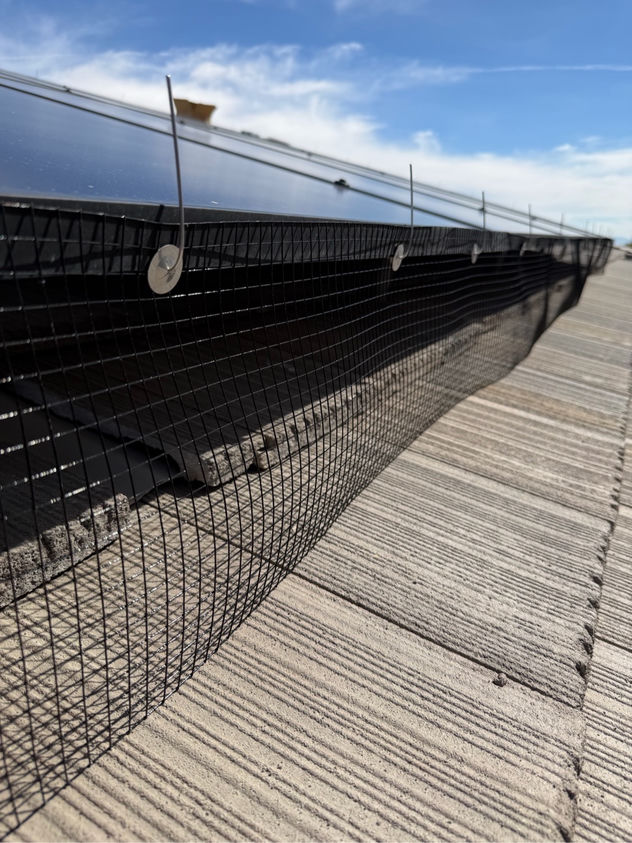
Option 3: Solar Panel Mesh (Pigeon Guard)
Solar panel mesh is a strip of stiff wire mesh that runs around the outside edge of your solar array. The top edge clips to the panel frame, and the bottom edge sits against the roof. That closes the gap all the way around, so birds can't get under.
Why it works:
- It closes the actual gap. This is the only option on the list that blocks the space where pigeons nest.
- It doesn't touch the glass. The mesh sits around the edge, not on top of the panels, so it doesn't block any sunlight.
- Air and water still get through. The open weave lets your panels breathe and lets rain drain away normally.
- No drilling needed. Good mesh clips onto the panel frames. There's no need to drill into your roof or your panels.
- It's hard to spot from the street. Black mesh blends in with the panel frames and shadows.
What to watch out for: mesh only works if it's installed carefully. Corners, conduit (the pipes that carry your solar wiring), and the dips in curved tile roofs are where gaps like to hide. One missed gap is all a pigeon needs.
This is how we do it at Neon. We use PVC-coated steel mesh, clip it to the panel frames without drilling, clean out what we can reach first, and include a full solar panel cleaning with every install. If the mesh we install ever comes loose, we come back and fix it for free.
Other Things People Try (and Why They Rarely Last)
- Fake owls and hawks: pigeons figure out pretty quickly that a plastic owl never moves. Most homeowners say the birds are back within a few weeks.
- Reflective tape and spinners: same story. They may scare birds off for a little while, then the birds get used to them.
- Sticky bird gel: it gets messy in the Las Vegas heat, collects dust, and has to be redone. It also does nothing to close the gap.
- Chicken wire and zip ties: the most common DIY fix we come across. Heat, sun, and roof wind wear it out, it doesn't sit flush against the frame, and pigeons find the gaps fast. Wire that isn't coated can rust and stain your roof.
Las Vegas tile roofs crack easily underfoot, and solar panel edges aren't safe to grab onto. If you're trying a DIY fix, the risk of a fall or a broken tile usually costs more than doing it right the first time.
Side-by-Side Comparison
| Question | Solar Panel Mesh | Spikes | Netting |
|---|---|---|---|
| Stops nesting under panels? | Yes | No | Sometimes, if it stays tight |
| Best used for | Rooftop solar arrays | Ledges, signs, ridges | Big open areas |
| Blocks sunlight on panels? | No | No | Can, if draped over the array |
| Easy to clean panels afterward? | Yes | Yes | Harder |
| Holds up in desert heat? | Yes, with coated steel | Depends on material | Plastic can get brittle |
| Looks from the street | Blends in | Visible on edges | Often visible, can sag |
Can You Use More Than One?
Yes, and sometimes it makes sense. Mesh keeps pigeons from nesting under the panels. If birds also like to sit on a nearby roof ridge, chimney cap, or patio beam and leave droppings below, spikes on that spot can help too. Think of it as mesh for the nest and spikes for the perch.
Questions to Ask Before You Hire Anyone
Whoever you call, these questions will tell you a lot about the job you're getting:
- What's the mesh made of? Look for coated steel made for solar panels, not hardware-store wire or plastic netting.
- Do you drill into the roof or panels? The answer should be no. Clips should attach to the panel frame.
- Do you clean out the nests and droppings first? Sealing in a mess isn't a fix. Ask what they can reach and what they can't.
- Is panel cleaning included? Panels under a pigeon problem are usually dirty too.
- How do you handle corners, conduit, and curved tile? That's where cheap installs leave gaps.
- What happens if the mesh comes loose? Get the answer in plain words before you pay.
The Short Answer
For pigeons under your solar panels in Las Vegas, Henderson, Summerlin, or North Las Vegas, go with mesh. It's the only option that closes the space pigeons use for nesting, and it does it without drilling, shading your panels, or sagging in the heat. Save spikes for ledges and netting for big open spaces.
The sooner mesh goes on, the easier the job is. A prevention install on a clean array is simpler and usually costs less than one where birds have been nesting for months. Read more about why pigeon proofing saves you money, or see how our solar panel pigeon proofing service works. We also have local pages for Henderson, Summerlin, North Las Vegas, and Mountain's Edge.
Frequently Asked Questions
Do bird spikes work on solar panels?
Not for nesting. Spikes stop pigeons from landing on a ledge or edge, but pigeons nest in the gap under the panels, and spikes don't close that gap. Spikes can still help on a nearby ledge or roof ridge where birds like to sit.
Is solar panel mesh better than bird netting?
For a home solar array, usually yes. Rigid mesh clipped along the panel edges closes the gap birds use and stays tight. Soft netting is better for large open spaces like courtyards or warehouse rafters. On a home roof it tends to sag, look messy, and get in the way of panel cleaning.
Will mesh around my solar panels hurt performance?
No. The mesh goes around the outside edge of the array, not over the glass, so it doesn't shade the panels. The open weave lets air and water pass through while keeping birds out.
Does pigeon mesh hurt the birds?
No. Mesh is a barrier, not a trap. It simply blocks the space under the panels so pigeons find somewhere else to nest. We clean out the area we can reach before sealing it off.
How much does pigeon proofing cost in Las Vegas?
We give a custom quote based on the number of panels, roof height, access, and how much cleanup is needed. A prevention install with no nests or droppings is usually simpler and cheaper. Every Neon install includes solar panel cleaning.