
7 Signs Pigeons Are Nesting Under Your Solar Panels in Las Vegas
You usually do not need to climb onto the roof to know pigeons have moved beneath your solar panels. Their routine leaves clues: birds disappearing under the array, cooing above an upstairs room, white streaks below the roofline, and twigs or feathers collecting where they should not. This guide shows you what to watch for, how to confirm the pattern safely, and what a proper next step looks like.
Why Las Vegas Solar Panels Attract Pigeons
A rooftop solar array creates exactly the kind of protected space pigeons look for in the desert. The panels provide shade, height, and cover, while the gap beneath them shields birds from much of the wind and direct sun. On curved tile roofs, the changing roofline can leave openings along the array perimeter that are easy for birds to explore.
Seeing one pigeon on the ridge does not automatically mean you have a nest. The pattern matters. When the same birds return, disappear under the same panel edge, and leave droppings or debris behind, the evidence becomes much stronger.
The 7 Signs Pigeons Are Under Your Solar Panels
1. Birds repeatedly disappear beneath the array
This is the clearest visual sign. Watch the roof around sunrise or in the cooler part of the late afternoon. A pigeon that simply rests on the ridge may fly away. A pigeon using the array as shelter will often walk along the panel edge, duck beneath it, and return to the same opening later.
Look for a repeated route rather than a one-time visit. Corners, conduit runs, and places where the tile line drops away from the panel frame are common entry points.
2. You hear cooing or scratching above an upstairs room
Pigeons become active early. If you hear cooing, shuffling, scratching, or wing movement above a bedroom around sunrise, the sound may be coming from the roof cavity beneath the solar array rather than from the open yard.
Sound alone is not enough to diagnose the problem. Pair it with a ground-level look at the roofline and note whether birds are repeatedly landing in that same section.
3. Droppings collect below one part of the roof
White streaks on fascia, stucco, gutters, patio areas, or the ground below the array often reveal where birds are entering and leaving. A few random marks can come from birds passing overhead. A concentrated trail beneath one corner of the solar system points to regular activity above it.
Also look at the lower panel edges from the ground. Droppings on the glass or frame near the same entry point are another clue that pigeons are spending time there.
4. Twigs, feathers, or debris appear near the panels
Nesting activity creates a mess that moves downhill. Small sticks, feathers, dried grass, and other material may collect in roof valleys, behind gutters, or on the tile below the array. Wind can move individual pieces, but a steady buildup in the same area deserves a closer look.
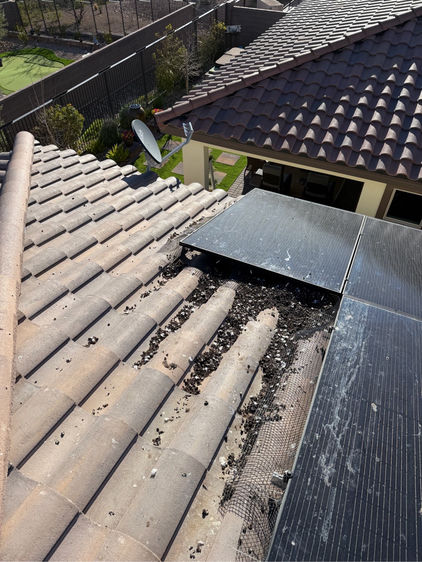
Las Vegas tile can crack under the wrong step, and the panel edge is not a safe handhold. Use binoculars, a phone camera with zoom, or ground-level photos. If the evidence is unclear, ask for an inspection instead of climbing up to prove it yourself.
5. The same area gets dirty again soon after cleaning
You rinse a patio, clean the side yard, or wash a window below the roof—and the droppings return in the same place a few days later. Recurring mess below one section of the array tells you the source is still active. Cleaning the surface underneath handles the symptom, not the nesting space above it.
6. One section of the array shows concentrated soiling
From the ground, you may notice one panel edge looks dirtier than the rest or has a cluster of droppings near it. This does not prove birds are under the panels, but it supports the other signs. It also means the panel surface itself may need cleaning once the nesting issue is handled.
If your monitoring app shows a production change, treat that as another clue—not a diagnosis. Dust, shade, equipment issues, weather, and normal seasonal changes can all affect output. Visible bird activity plus concentrated soiling is more meaningful than a production number by itself.
7. Existing pigeon mesh is sagging, open, or pulled away
If the home already has bird guard, inspect its outline from the ground. Mesh that bows outward, lifts at a corner, stops short around conduit, or leaves an opening over an uneven tile can become an entry route. Pigeons do not need the entire guard to fail; one usable gap is enough.
Loose mesh also explains why a problem can return after a previous installation. The repair needs to close the actual opening and check the complete perimeter, not simply press one visible section back into place.
How to Confirm the Pattern Without Climbing
- Watch the roof for 10 to 15 minutes near sunrise. Note where birds land and whether they disappear beneath a specific panel edge.
- Listen from the upper floor. Record where the cooing or movement sounds strongest.
- Photograph the roofline from several angles. Zoom in on corners, conduit, mesh seams, droppings, and debris.
- Check the ground below the same area. Look for a concentrated mess rather than scattered marks around the property.
- Compare clues. Two or more signs pointing to the same part of the array are more useful than one isolated observation.
When requesting an estimate, include the property address plus clear photos of the entire solar array and the side where birds enter. Panel count, roof height, access, perimeter length, and the amount of visible cleanup all help define the scope.
What to Do If the Signs Point to Nesting
Do not block the first opening you see without checking the rest of the perimeter. A rushed patch can leave other gaps open or close off an area before the active situation has been properly assessed. The goal is a complete exclusion—not moving the problem from one corner to another.
A professional pigeon-proofing visit should account for:
- The panel layout, roof height, tile condition, and safe access
- The edges, corners, seams, conduit, and uneven tile lines birds can use
- Accessible nests, droppings, feathers, and debris that need to be removed
- Panel cleaning after the under-panel area is handled
- A secure fit that still leaves normal airflow and drainage paths open
At Neon, every solar panel pigeon-proofing installation uses PVC-coated steel mesh clipped to the panel frames without drilling into the roof or panels. Solar panel cleaning is included, and if mesh installed by Neon ever comes loose, we return and fix it free.
Why It Is Easier to Handle Early
A prevention install on a clean array is simpler than a job with established nests, droppings, feathers, and debris. Waiting does not guarantee major damage, but it does give the mess more time to build and the birds more time to treat the space as part of their routine.
If pigeons are only scouting the roof, closing the perimeter early may keep the job straightforward. If they are already established, the quote needs to account for what can be accessed safely and what cleanup is possible without removing the solar panels.
Frequently Asked Questions
What are the clearest signs that pigeons are nesting under solar panels?
The clearest signs are birds repeatedly disappearing beneath the array, cooing or scratching around sunrise, droppings below the roofline, and twigs or feathers collecting near the panels. Any one clue may have another cause, but several together strongly suggest nesting activity.
Why do pigeons nest under solar panels in Las Vegas?
The gap beneath a rooftop solar array gives pigeons shade, height, and shelter from weather and predators. Las Vegas tile roofs can also create uneven openings around the panel perimeter that give birds an easy route underneath.
Can you hear pigeons under solar panels?
Yes. Homeowners often notice cooing, scratching, shuffling, or wing movement above a bedroom or upper floor, especially around sunrise when pigeons become active. Sound alone is not proof, so pair it with a ground-level visual check.
Will pigeons leave solar panels on their own?
They may leave temporarily, but birds that have established a sheltered nesting spot often keep returning. The durable solution is to handle accessible nesting debris and then close the panel perimeter with properly fitted exclusion mesh.
Can I install solar panel pigeon mesh myself?
The mesh itself looks simple, but the work requires roof access, careful movement on fragile tile, and a tight fit around corners, seams, conduit, and uneven roof lines. Loose sections or small gaps can let pigeons return. Professional installation is the safer choice for most homeowners.
Does pigeon mesh have to be drilled into the roof or solar panels?
No. Neon Window Cleaning uses a no-drill system that clips PVC-coated steel mesh to the panel frames instead of drilling into the roof or panels. Homeowners should still confirm any equipment-specific requirements with their solar provider.