When to Replace Your Window Screens: 7 Signs Yours Are Shot
Window screens are one of those home features that look fine until they don’t. The mesh fades a little, the frame oxidizes a little, the panel sags a little — and then one day a stiff breeze pulls the screen out of the window or you notice you can see straight through the wave in the mesh. In the Las Vegas climate, that decay timeline is faster than most homeowners expect.
Here are the seven signs we look for during an on-site measure to tell whether a screen is past saving. If your screens hit two or more of these, it’s replacement time.
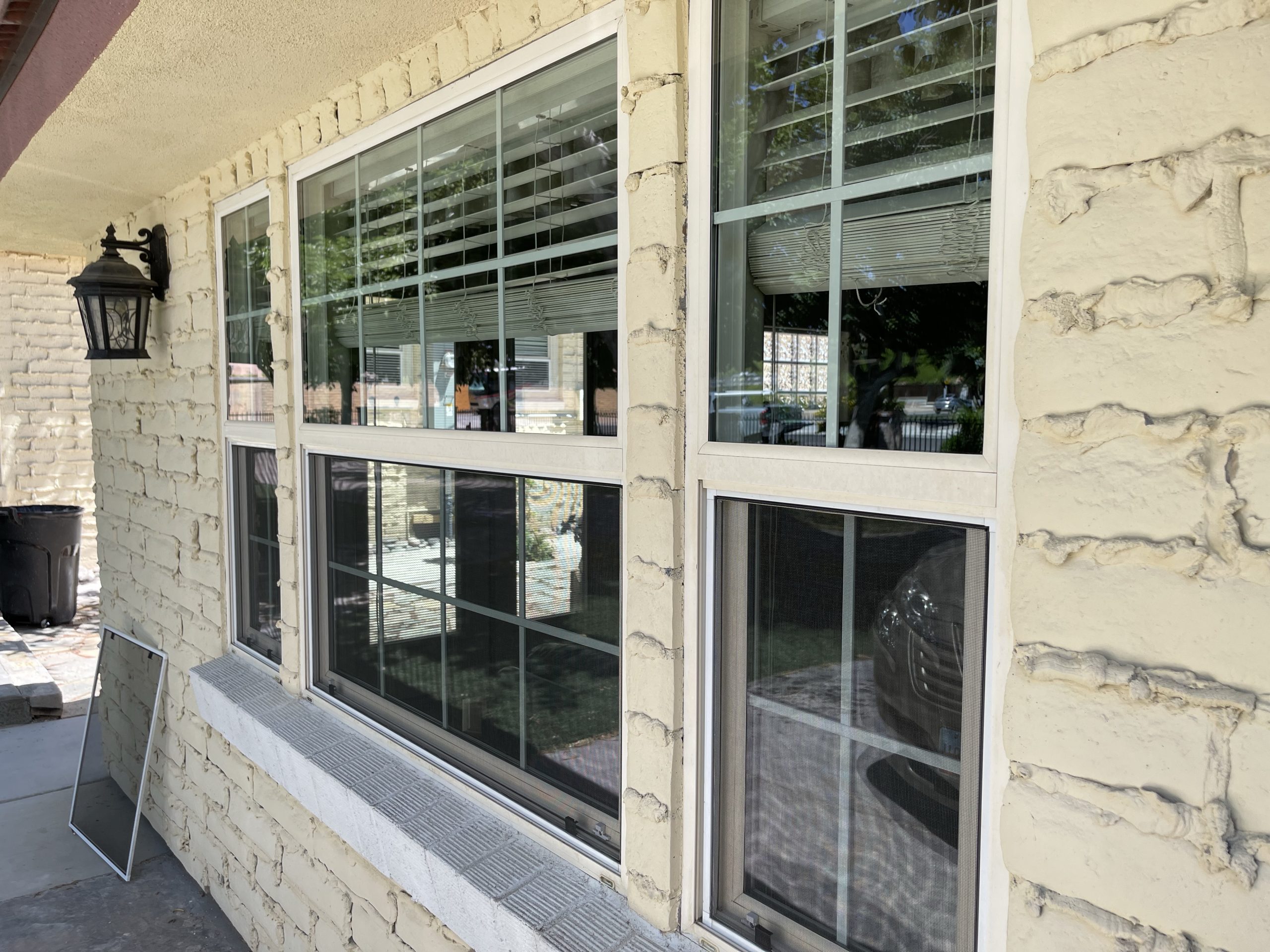
1. Mesh Tears at the Corners or Seams
The most common failure mode. Fiberglass mesh in Las Vegas slowly stiffens as UV breaks down the polymer coating, and the four corners of every screen are the highest-stress points. Once a tear starts at a corner, it propagates — sometimes overnight in heavy wind. A 1" tear today is often a 6" tear next month.
You can’t patch fiberglass mesh durably. The patch never matches tension and looks rough from outside. Replace the screen.
2. Mesh Sags or Has a “Wave” You Can See Through It
Press a finger gently against the center of the screen panel. If the mesh has visible give — bowing in 1/4" or more before it stops — the tension is gone. Properly tensioned mesh barely moves under finger pressure.
You can sometimes spot this from outside before you even touch the screen: stand back 10 feet on a sunny day and look at the panel. Tight mesh looks like a flat dark plane. Sagging mesh shows ripples and waves where light passes through unevenly. Once mesh sags, it doesn’t recover — the spline channel has stretched and the only fix is new mesh in a new (or rescreen-capable) frame.
3. Aluminum Frame Is Oxidized
Run a fingertip along the aluminum rail. If your finger comes back chalky white or pitted with tiny holes, the frame is oxidizing — aluminum’s slow corrosion in dry desert air, accelerated by UV. Light oxidation is cosmetic. Heavy oxidation weakens the metal and means the frame won’t hold a new mesh tension cleanly.
This is most common on west and south-facing screens that have taken years of direct afternoon sun. Older builder-grade frames oxidize faster than aftermarket aluminum because the wall thickness is thinner.
4. Frame Is Bent, Twisted, or No Longer Square
Pull the screen out of the window and lay it on a flat surface. The four corners should all touch the floor at once. If one corner lifts off the surface, the frame is twisted. If you can see a bow when looking down the long edge, the frame is bent.
Bent and twisted frames pop out of window openings under wind load, leave gaps that bugs come through, and won’t latch consistently. Worse, the warp keeps progressing — you can’t bend it back, and re-tensioning new mesh on a non-square frame is futile. Replace it.
5. Screen Won’t Latch or Pops Out of the Window
The plastic latch tabs on most window screens are the second-fastest thing to fail after the mesh itself. Once they crack, the screen sits in the window opening but doesn’t lock in — any decent wind blows it out. Same outcome if the frame is bent enough that it no longer fits the opening properly.
If the latches are cracked but the rest of the screen is good, you can sometimes find replacement clip kits. In practice, by the time the latches fail the rest of the screen is usually showing other signs from this list, so a full replacement is the simpler call.
6. Mesh Has Gone Brittle (the Fingertip Test)
Press a fingernail gently into the center of the mesh and release. Healthy fiberglass mesh has a slight elastic give; it springs back smoothly. Brittle UV-degraded mesh feels papery and holds a tiny dent where you pressed. If you can hear the mesh crinkle when you flex it, the polymer is shot.
Brittle mesh tears the next time desert wind hits it hard, often in pieces rather than a single rip. Catch this sign before the tearing starts and you’ll save yourself a frantic call after the next storm.
7. Builder-Grade Mesh That Ripples in Light Wind
Most production homes ship with the cheapest fiberglass mesh in the lightest-duty aluminum frames the builder can get away with. You can spot it from across the yard: the mesh ripples or flutters in any wind, even when nothing else around the house is moving. The aluminum is also noticeably thinner than aftermarket frames — a finger flick on the rail produces a hollow tinny ring instead of a solid thunk.
Builder-grade screens typically don’t make it to the 10-year mark. If your home is post-2010 and you’re still on the original screens, you’re running on borrowed time. Aftermarket replacements with proper aluminum and properly tensioned standard fiberglass hold up dramatically longer.
The Honest “Why We Don’t Rescreen” Caveat
You’ll see some shops advertise rescreening for window screens — pulling the old mesh, putting in new mesh, sending you on your way. We don’t do that on standard window-screen frames, and here’s why: the lighter-duty aluminum on window screens warps after years of sun, the spline channels get damaged, and even a perfectly executed rescreen on a 10-year-old window-screen frame sags within months because the frame can’t hold tension cleanly.
Building a new screen with new aluminum frame, new spline, and properly tensioned mesh costs only marginally more than a rescreen but lasts dramatically longer. So we install new custom screens for window openings.
The exception is sliding screen doors — those have heavier-duty frames that tolerate rescreening well. We covered that decision in detail in our sliding screen door replacement guide.
What Replacement Actually Costs
Most standard window screens land around $65 each with a 3-screen minimum. Final pricing depends on the size of each opening, the count, and any sliding screen door work included. Larger picture-window screens run higher, smaller bath and bedroom screens run lower. Mobile service: we measure on-site, build new screens to your exact dimensions, and install in a single visit. Full pricing breakdown is here.
Replace All at Once or in Stages?
Either works, with one important nuance: when you start seeing failure on multiple screens at once, the rest are usually within a year or two. If your home is post-2010 and three screens are torn, the other ten are probably brittle and ready to fail too. Replacing in waves means more measure visits and more invoices. Replacing all at once usually saves on the per-screen rate and gives you a clean fresh look across the whole exterior.
That said, if budget is a constraint, prioritize:
- Worst-damaged screens first. Anything torn, sagging, or popping out of the window.
- Ground-floor and street-facing windows. Curb appeal counts — bad screens lower the look of the whole home.
- Bedroom screens you actually open. Functionality matters more here than on a never-opened window.
- Skip the upper-floor never-opened ones. If you can’t even reach the window and the screen looks fine from the ground, that one can wait.
Custom Screens Built for Your Windows
If you spotted two or more signs from this list, your screens are due. We measure on-site, build new custom window screens to your exact openings with properly tensioned standard fiberglass mesh and durable aluminum frames, and install in a single visit. Explore our full custom window screens service for the complete pricing and method, or check the dedicated pages for Summerlin, Henderson, Southern Highlands, and other valley areas.
Got a sliding screen door that’s on the same downhill slope? Read our sliding screen door replacement guide for the rescreen-vs-replace decision (sliders are different from window screens — we do rescreen those).